

AIWallRun Team · Published 2026-11-01
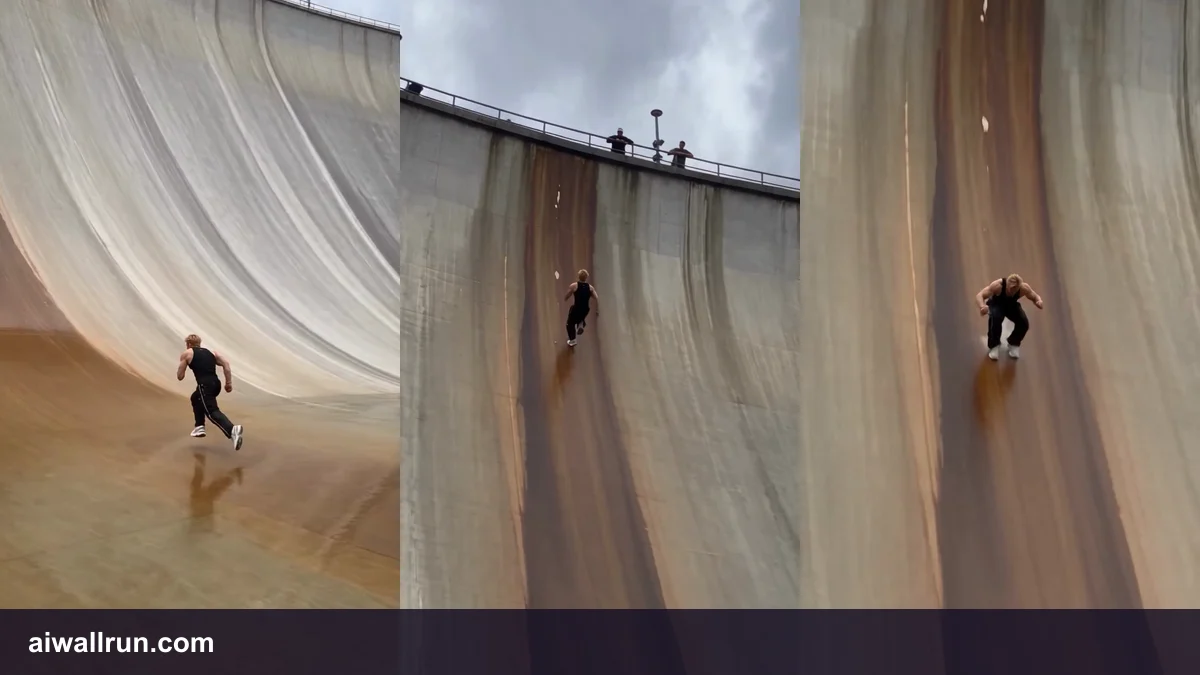
The AI Wall Run Trend Explained: What It Is and Is It Real?
If you have scrolled TikTok, Reels or X recently, you have probably seen it: a runner sprints up an impossibly tall, curved concrete wall, flips off the top and lands while a crowd roars. The comments are always the same question: is this real? This article explains what the AI wall run trend is, where the dam version came from, why the clips are AI-generated, and how to tell an AI stunt video from a real one.
What Is the AI Wall Run?
The AI wall run is a family of short AI-generated videos built around one idea: a single athlete running up a wall far too big and too steep for any human, in front of an audience. Versions use stadium ramps, city landmarks and, most famously, a dam.
The dam version, which many people call dam sprint AI or the dam wall run, follows a fixed sequence:
- A runner starts at the base of a huge curved dam, next to a line of guards, with a packed grandstand behind them.
- They sprint up the wet concrete face as it bends from a gentle slope toward vertical.
- At the crest they flip above the railing.
- They land back on the wall in a burst of spray and slide down toward the camera.
- The clip ends on a close-up of the runner celebrating.
It is filmed, or rather generated, as one vertical handheld take with no cuts, which is a big part of why it feels real.
Where Did the Dam Wall Run Come From?
Stunt-running clips of this kind spread through October 2026. By the end of the month the dam version was being reposted widely on X, often with captions presenting it as a real athlete. On 31 October 2026, one repost on X captioned "This girl is really impressive out there" had 173 likes and 75 replies when we checked it on 1 November 2026, and many of those replies asked whether it was real. A day earlier, a Japanese post on X pointed out that there were no puddles on the wall before the runner climbed it, which is why the poster thought it was AI; that post had more than 4.3 million impressions when we checked.
Soon after, AI video sites launched templates that let anyone put their own face on the runner. That is the point where a viral clip turns into a trend: people stop asking "who is she?" and start asking "how do I make one?"
Is the AI Wall Run Real?
No. The viral wall run clips are AI-generated videos, not footage of real stunts.
The move that inspired them is real. A wall run is a genuine parkour technique: a few fast steps up a vertical wall to reach a ledge. Skilled athletes can run a few metres up a wall. What no person can do is sprint the full height of a dam, keep accelerating as the surface turns vertical, flip off the top and land back on the same wall.
That gap between a real skill and an impossible scale is exactly why the clips work. They look like something an elite athlete might almost do.
How to Spot an AI Wall Run Video
You do not need special software. Most AI stunt videos give themselves away if you watch closely.
| Sign | What to look for |
|---|---|
| Physics | The runner keeps full speed as the wall turns vertical, or hangs in the air too long during the flip. |
| Bodies | Pause during fast moves: hands, feet or limbs may blur, stretch or disappear. |
| Water and surfaces | Spray, puddles or wet patches appear or vanish without a cause. |
| Crowd | Spectators look away from the action, or phones filming show nothing on screen. |
| Consistency | Count the guards at the start and at the end; AI often changes the number. |
| Labels | Check for platform AI labels, #AI tags or a watermark in a corner. |
No single sign proves anything. Several together are a strong hint.
Why the Trend Took Off
It is easy to understand in one second. A person, a wall, a crowd. No language needed, which is why the clips spread across countries.
The comments argue. "Real or AI?" debates push posts into more feeds.
It is personal. Once templates exist, the question becomes "what would I look like up there?" Putting yourself, or a friend who agreed, on the wall is far more shareable than reposting a stranger.
The format is ready-made. A vertical, sub-20-second clip with a clear payoff fits every short video platform.
How to Join the Trend Responsibly
- Use your own photo, or get permission. Never put someone on the wall without their consent, and do not use photos of public figures.
- Label it as AI. Use your platform's AI label and add #AI. Do not present the clip as a real stunt.
- Do not try it for real. Running up a dam spillway is dangerous and, in most places, illegal.
Make Your Own AI Wall Run
Our AI Wall Run generator turns one photo into the full sequence: the dam sprint, the flip at the top and the landing. Follow the step-by-step guide to making an AI wall run video, or browse AI wall run video examples first.
FAQ
What is the AI wall run trend?
A wave of AI-generated videos from October 2026 in which one runner sprints up a giant wall, most famously a curved dam, in front of a crowd, flips at the top and lands.
Is the dam wall run video real?
No. It is an AI-generated video. No one can run the full height of a dam and flip off the top.
Is wall running a real parkour move?
Yes. A real wall run covers a few metres up a vertical wall to reach a ledge. The AI clips exaggerate it to an impossible scale.
How can I tell if a stunt video is AI?
Look for impossible physics, limbs that blur or vanish in fast moves, water that appears from nowhere, crowds that do not react and platform AI labels.